Meta & Anthropic Lead Big Releases Across AI Labs This Week
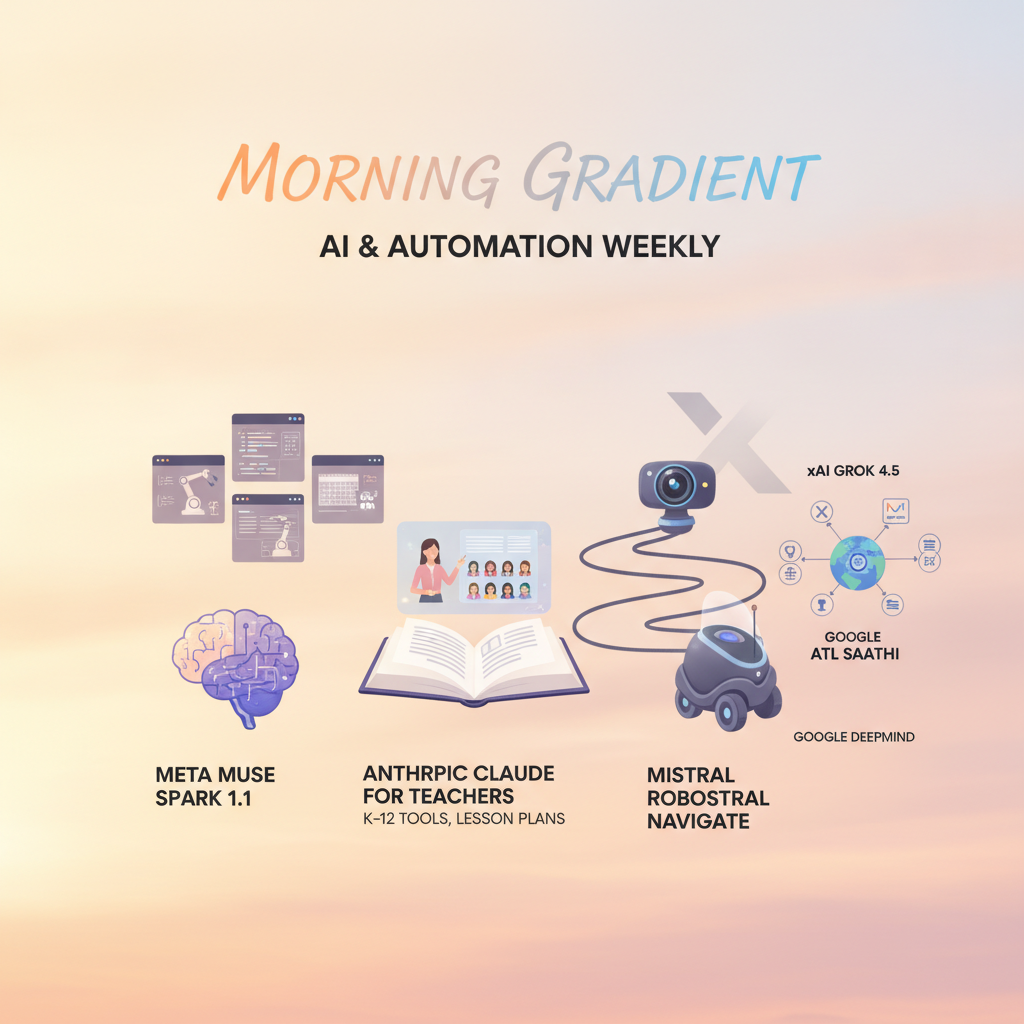
The frontier labs appear to have collectively decided that sleep is a vestigial human trait this week. From multimodal reasoning models that can navigate codebases to robotic navigation systems that see the world through a single lens, the pace of shipping remains relentless. This roundup covers the latest agentic tools, educational integrations, and physical AI developments that are currently shaping the landscape. If your development queue was looking manageable, these five updates are here to rectify that.
Introducing Muse Spark 1.1
META — The release of Muse Spark 1.1 marks a push into high-context, agentic workflows. This multimodal reasoning model features a 1-million-token context window and is specifically designed to orchestrate multi-agent systems. By utilizing parallel subagents, the system aims to reduce end-to-end latency, making it particularly effective for complex coding tasks that involve large, real-world codebases.
For developers, the launch includes a public preview of the Meta Model API, which is compatible with OpenAI’s standards. The model stands out for its zero-shot generalization to new native tools and its ability to intelligently combine computer use with scripting. Rather than simply clicking through every step of a task, the model can script more efficient paths, signaling a shift toward more autonomous and capable AI agents.
Introducing Claude for Teachers
ANTHROPIC — Anthropic has tailored its flagship model for the classroom with the launch of Claude for Teachers. This specialized offering provides verified K-12 educators in the US with free access to premium capabilities and a library of evidence-based teaching skills. It integrates with existing educational ecosystems like Canva Education and MagicSchool to help automate recurring tasks, such as analyzing nightly student exit tickets.
The system is connected to Learning Commons, which allows the model to access academic standards across all 50 states. This ensures that lesson plans are scaffolded correctly and aligned with local curricula. To address the sector’s stringent requirements, the product includes FERPA-compliant data handling and a K-12 Data Processing Addendum, backed by a pilot program with Detroit Public Schools.
Introducing Grok 4.5
XAI — SpaceXAI has announced Grok 4.5, positioning it as the lab’s smartest model to date—a title that usually lasts until the next press release. The model is described as having particular strengths in coding, agentic tasks, and general knowledge work. While the initial announcement indicates a significant step forward in reasoning capabilities, detailed technical specifications and benchmark figures remain sparse for the time being.
The model’s release was confirmed via a dedicated news entry this week. Early descriptions suggest that the focus remains on high-performance agentic behavior and utility for complex professional tasks. As more details on the context length and API availability emerge, developers will be better able to assess its place among its contemporaries in the frontier class.
Introducing Robostral Navigate
MISTRAL — Moving from the digital to the physical, Mistral introduced Robostral Navigate, an 8B model designed for embodied robotic navigation. In a departure from multi-sensor setups, this model operates using only a standard RGB camera. It achieved a 76.6% success rate on the R2R-CE benchmark, outperforming existing systems that rely on depth sensors or LiDAR by significant margins.
The model’s training utilized a tree-based attention-masking strategy called prefix-caching, which reduced the required training tokens by 22 times. This efficiency allowed months of training to be compressed into days. Robostral Navigate is built to generalize across various hardware formats, including wheeled, legged, and flying robots, marking a notable entry for the lab into industrial and logistics applications.
Empowering India’s next generation of innovators with ATL Saathi
GOOGLE DEEPMIND — Google DeepMind, in collaboration with India’s Atal Innovation Mission, has launched a pilot for ATL Saathi. This Gemini-powered web application serves as a persistent AI assistant for educators at Atal Tinkering Labs. The tool generates grade-appropriate project ideas, infographics, and step-by-step assembly instructions, all grounded in national curriculum standards.
A central feature of the application is its multilingual support, which is set to launch in eight Indian languages. By utilizing Gemini 3.5 Flash, the tool aims to reduce the administrative burden on teachers while fostering innovation among the millions of students currently reached by the program. The pilot is currently rolling out to 100 schools across the country.
This week’s releases signal a clear shift from general-purpose chatbots toward specialized, agentic tools. Whether it is Meta optimizing for multi-agent orchestration, Mistral moving into embodied AI, or Anthropic and Google DeepMind verticalizing for education, the focus has moved to what these models can do in specific environments. As labs climb the ever-expanding ladder of version numbers, the real competition is now occurring at the level of practical, real-world utility.
Sources and Further Reading
- Introducing Muse Spark 1.1, Meta, 2026-07-09
- Introducing Claude for Teachers, Anthropic, 2026-07-14
- Introducing Grok 4.5, xAI, 2026-07-08
- Introducing Robostral Navigate, Mistral, 2026
- Empowering India’s next generation of innovators with ATL Saathi, Google DeepMind, 2026-07-14
Discover more from Morning Gradient
Subscribe to get the latest posts sent to your email.