Agents, Alignment & Compression: AI’s Hottest Week in July
Research this week suggests we are moving past the “bigger is better” era and toward a more surgical approach to artificial intelligence. We are seeing major strides in how models navigate our digital desktops, how we measure their actual learning versus rote memorization, and how we can fix their biases without starting from scratch. It is a relief to see that while we struggle to find the right file in a crowded folder, AI agents are beginning to master the entire operating system.
-
Requential Coding: Pushing the Limits of Model Compression with Self-Generated Training Data
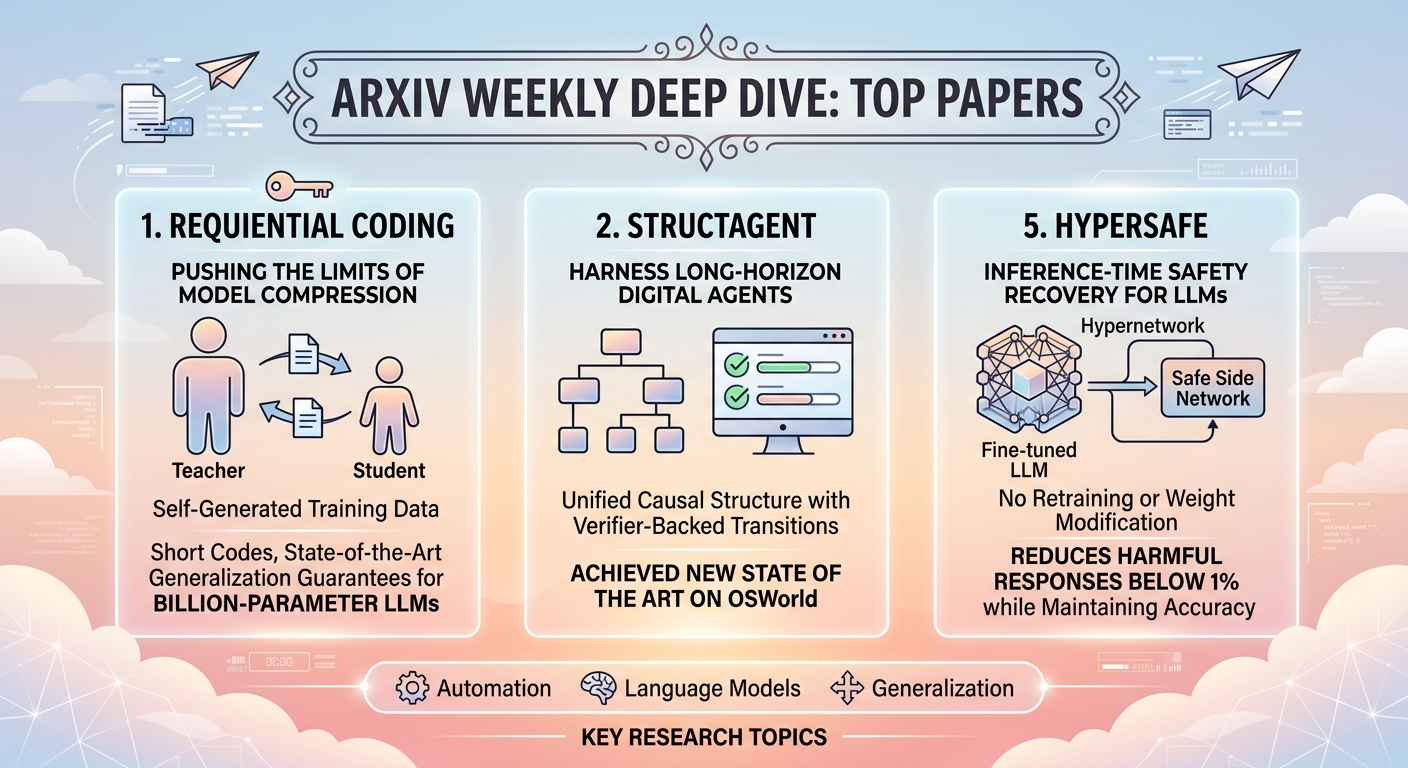
This paper introduces Requential Coding, a compression framework that fundamentally changes how we calculate the “cost” of a model. Instead of saving every parameter, a teacher model selects training samples from the student’s own distribution and records only the specific instances where they disagree. This method of recording only errors makes the resulting code length independent of the model’s total parameter count.
By applying this to massive language models, the researchers derived state-of-the-art generalization guarantees that outperform traditional methods. It suggests that our current billion-parameter models might be far more efficient at learning than their storage requirements suggest, providing a principled way to distinguish genuine learning from simple data memorization.
Authors: Shikai Qiu, Marc Finzi, Yujia Zheng, Kun Zhang, Andrew Gordon Wilson
-
StructAgent: Harness Long-horizon Digital Agents with Unified Causal Structure
Creating an AI that can navigate a computer is difficult because one wrong click can derail a complex task. StructAgent solves this by using a unified causal structure that allows the agent to check its progress and recover from failures. It effectively gives the AI a “checkpoint” system, allowing it to maintain task progress and recover when things go wrong rather than starting from the beginning.
The results are a major milestone for open-source systems, with the framework lifting model success rates significantly on the OSWorld benchmark. Achieving a 78.9% success rate with the MiniMax-M3 model demonstrates that causal structure is a viable path toward creating agents that are not only capable but also interpretable and resilient in long-term tasks.
Authors: Wenyi Wu, Sibo Zhu, Kun Zhou, Aayush Salvi, Zixuan Song, Biwei Huang
-
SCALECUA: Scaling Computer Use Agents with Verifiable Task Synthesis and Efficient Online RL
While architectural changes are vital, ScaleCUA from the THUDM group tackles the massive data bottleneck facing computer-use agents. The researchers built a pipeline called VeriGen that runs over 100 concurrent workers to produce thousands of verifiable tasks. This allows for training via Reinforcement Learning from Verifiable Rewards (RLVR) without the need for scarce human-annotated data.
The team also introduced Visual Context Segmentation, which speeds up training by nearly three times. By focusing the model’s attention on the most relevant digital regions and allocating resources to the “capability frontier,” they have pushed open-source performance to new heights across diverse benchmarks like ScienceBoard and OSWorld.
Authors: Bowen Lv, Xiao Liu, Yanyu Ren, Hanyu Lai, Bohao Jing, Hanchen Zhang, Yanxiao Zhao, Shuntian Yao, Jie Tang, Yuxiao Dong
-
Inside the Unfair Judge: A Mechanistic Interpretability Account of LLM-as-Judge Bias
We often use strong AI models to grade the outputs of others, but those “judges” have hidden biases. This study moves beyond simply noting these errors and looks at the underlying neural representations. The researchers discovered that bias exists in a specific, low-dimensional “subspace” within the model’s hidden layers. It appears the judge isn’t having a bad day; it just has a fundamentally skewed perspective hardwired into its activations.
By identifying these features, the team was able to causally steer the model’s scores, effectively increasing or decreasing bias by manipulating its hidden states. This mechanistic understanding is critical for building more reliable AI assessment pipelines and ensuring that our evaluation models are as objective as we assume them to be.
Authors: Zixiang Xu, Sixian Li, Huaxing Liu, Xiang Wang, Shuai Li, Zirui Song, Xiuying Chen
-
HyperSafe: Inference-Time Safety Recovery for Fine-Tuned Language Models
Fine-tuning a model to learn a new skill often degrades its original safety training. HyperSafe offers a way to restore that safety alignment without the need for expensive retraining or modifying the model’s weights. It uses a hypernetwork to read the “fingerprints” of a model’s activations and generate a Safe Side Network (SSN) that acts as a real-time guardrail.
In practice, this allows the system to route harmful prompts to a refusal response while passing safe queries through to the original model completely untouched. Tests on LLaMA-3 and Qwen2 showed that harmful responses could be slashed from 30% to under 1% without impacting the model’s performance on its specialized downstream tasks.
Authors: Aznaur Aliev, Carlos Hinojosa, Abdelrahman Eldesokey, Bang An, Bernard Ghanem, Yibo Yang
The research this week underscores a transition toward maturity in the field. We are moving from the excitement of raw scale to the precision of causal structures, mechanistic understanding, and post-hoc safety controls. As these theoretical insights and data pipelines continue to converge, the prospect of truly autonomous, reliable, and safe digital assistants moves from the lab into the real world.
Sources and further reading
- Requential Coding: Pushing the Limits of Model Compression with Self-Generated Training Data by Qiu et al.
- StructAgent: Harness Long-horizon Digital Agents with Unified Causal Structure by Wu et al.
- SCALECUA: Scaling Computer Use Agents with Verifiable Task Synthesis and Efficient Online RL by Lv et al.
- Inside the Unfair Judge: A Mechanistic Interpretability Account of LLM-as-Judge Bias by Xu et al.
- HyperSafe: Inference-Time Safety Recovery for Fine-Tuned Language Models by Aliev et al.
Discover more from Morning Gradient
Subscribe to get the latest posts sent to your email.