Trending Github Repos for the past week
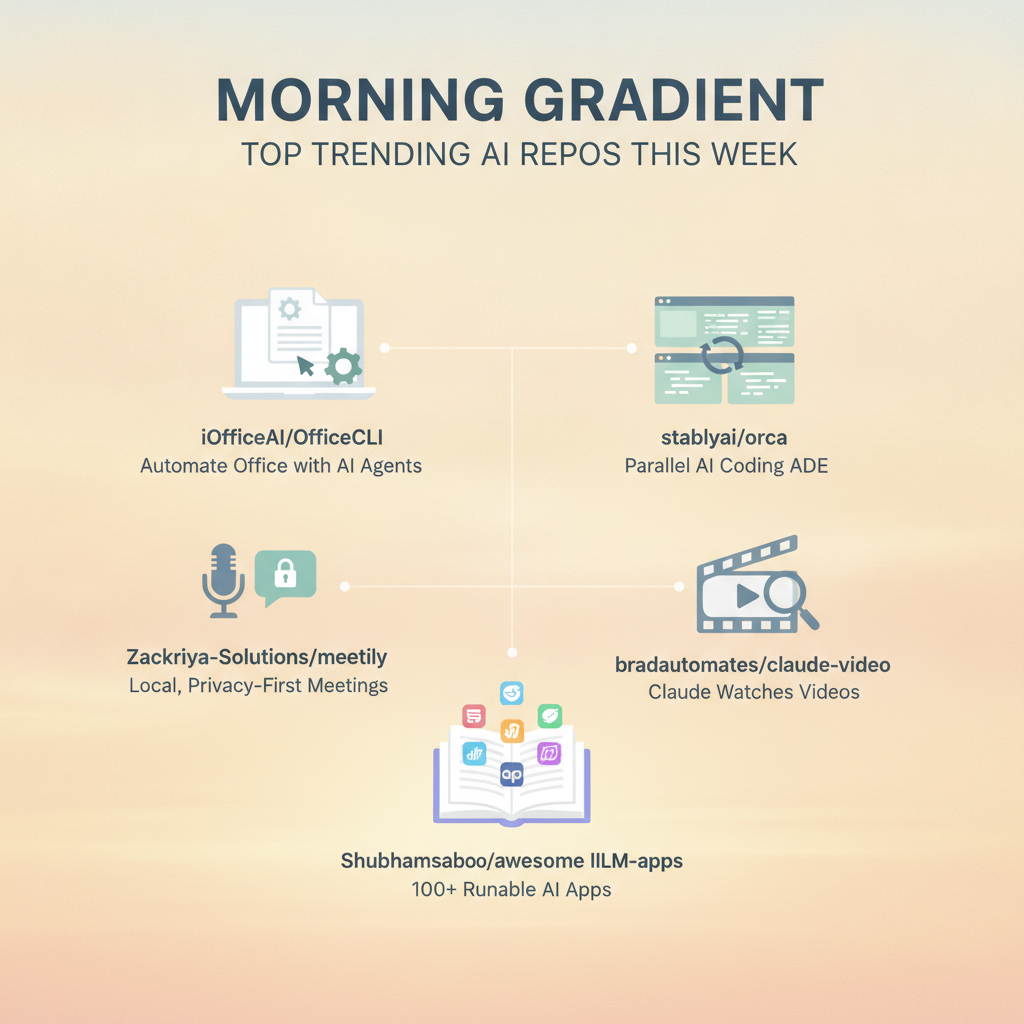
GitHub’s trending page is currently a reflection of our collective desire to move past simple chat interfaces into something more functional. This week, we see a shift toward high-performance local hosting and tools that treat document parsing with the respect it deserves. It appears the community is finally realizing that an AI is only as good as the PDFs it is forced to read. Here are the top repositories shaping the landscape this week.
open-webui/open-webui
Open WebUI continues to dominate the self-hosted interface space, boasting an impressive 54,000 stars. Written in TypeScript, it serves as a versatile bridge between users and a variety of large language models, whether they are running locally via Ollama or through OpenAI-compatible APIs.
The project provides a feature-rich environment that includes Retrieval-Augmented Generation (RAG) support and multi-model conversations. It is designed to be extensible, allowing developers to integrate custom plugins and maintain a polished interface without the overhead of proprietary ecosystems.
DS4SD/docling
Developed by the team at IBM, Docling addresses the perennial headache of document ingestion. This Python-based library, which has secured 12,500 stars, focuses on converting complex formats like PDFs, DOCX, and images into clean Markdown or JSON.
While other tools often struggle with layout integrity, Docling prioritizes maintaining structural information. This makes it an essential component for teams building RAG pipelines who would prefer their models not hallucinate simply because a table was parsed into a chaotic string of text.
khoj-ai/khoj
Khoj positions itself as a private, open-source personal assistant designed to sit on top of your personal data. With 21,000 stars, this Python project allows users to search through their notes, emails, and images using natural language.
The emphasis here is on self-hosting and data sovereignty. It attempts to unify disparate data sources into a single, searchable interface, ensuring that your digital brain remains yours rather than becoming fuel for a distant server farm.
huggingface/parler-tts
Hugging Face’s entry into high-quality speech synthesis, Parler-TTS, is gaining traction with 6,200 stars. This Python library focuses on controllable text-to-speech models, allowing developers to fine-tune attributes like pitch and rhythm.
In a world where many AI voices sound suspiciously like they are reading a grocery list at gunpoint, Parler-TTS offers a path toward more natural, emotive audio. It provides both inference and training capabilities for those looking to build more expressive vocal interfaces.
Significant-Gravitas/AutoGPT
AutoGPT remains a titan in the autonomous agent space, holding a staggering 168,000 stars. This experimental Python project attempts to grant GPT-4 full autonomy, enabling it to break down complex goals into executable sub-tasks.
While the dream of an AI that handles your entire job remains a work in progress, AutoGPT is the primary vehicle for exploring how models can reason and execute actions without constant human intervention. It represents the ambitious, if slightly chaotic, frontier of agentic AI development.
This week’s selection highlights a maturation in the AI ecosystem. We are moving away from novelty toward infrastructure that supports local control, better data handling, and autonomous execution. The focus on making models more useful in private environments suggests that the next phase of development will be less about the models themselves and more about the tools that make them work for us.
Sources and Further Reading
- open-webui/open-webui: User-friendly WebUI for LLMs (Local, OpenAI, DALL-E etc.)
- DS4SD/docling: Docling parses PDF, DOCX, PPTX, Images and more to Markdown and JSON.
- khoj-ai/khoj: Your AI personal assistant. Get answers to questions from your notes, docs and images.
- huggingface/parler-tts: Inference and training library for high-quality, controllable text-to-speech models.
- Significant-Gravitas/AutoGPT: An experimental open-source attempt to make GPT-4 fully autonomous.
Discover more from Morning Gradient
Subscribe to get the latest posts sent to your email.